image description
Johns Hopkins Univeristy logo

Department of Earth and Planetary ScienceEarth and Planetary Sciences

 Kreiger School of Arts and SciencesUniversity CalendarUniversity NewsSearch JHU


About the Department

Open Positions

Undergraduate Program

Graduate Program

Calendar of Events

People Directory

News

Contact Information

Home


Department of Earth and
Planetary Sciences
Johns Hopkins University
301 Olin Hall
3400 N. Charles Street
Baltimore, MD 21218

Phone 410-516-7135
Fax 410-516-7933

Starting Fall 2009

Global Environmental Change and Sustainability

Overview

The Global Environmental Change and Sustainability (GECS) major and minor are interdepartmental programs introducing students to the science of the Earth and its living and nonliving systems as well as how humans interact with Earth and its natural systems and how humans can use powerful tools, such as policy and communication to harm or help those systems. The goals are to advance awareness of the magnitude and consequences of these issues and to train the next generation of problem-solvers who will address the effects of global environmental change. Students' backgrounds are typically specialized within traditional disciplines; a primary purpose of this major is to develop the ability of students to venture beyond the confines of those disciplines. Students will be exposed to theory, research, and the practical applications of both throughout their coursework.

Curriculum for Major

The major in GECS will provide all of its students with a solid background in the study of both the environmental science and social science of our changing world with the core requirements for all majors. After completing the core requirements, students will be allowed to choose either the Science or Social Science concentration for more in-depth study in their area of greater interest. While allowing students to concentrate, however, both concentrations will continue to require some courses in both environmental science and social science; the proportion will depend on the concentration.

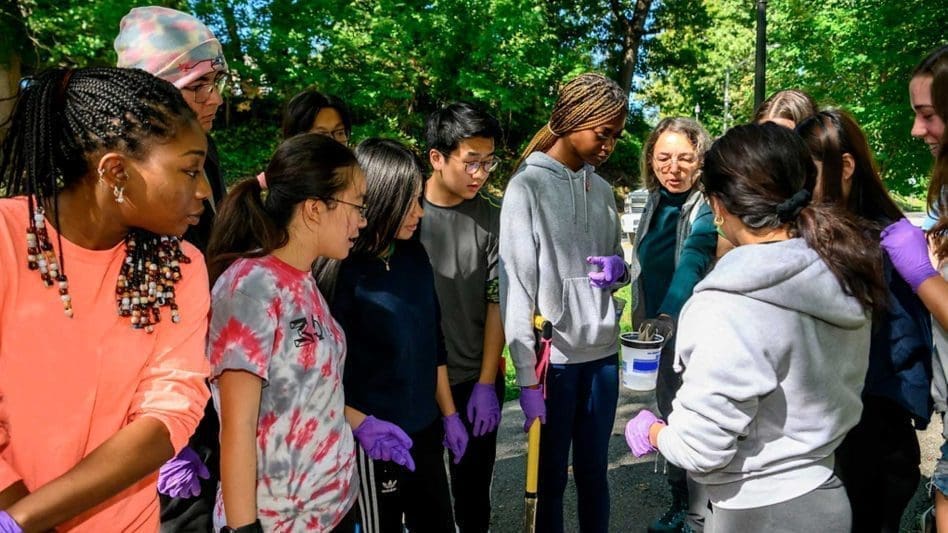
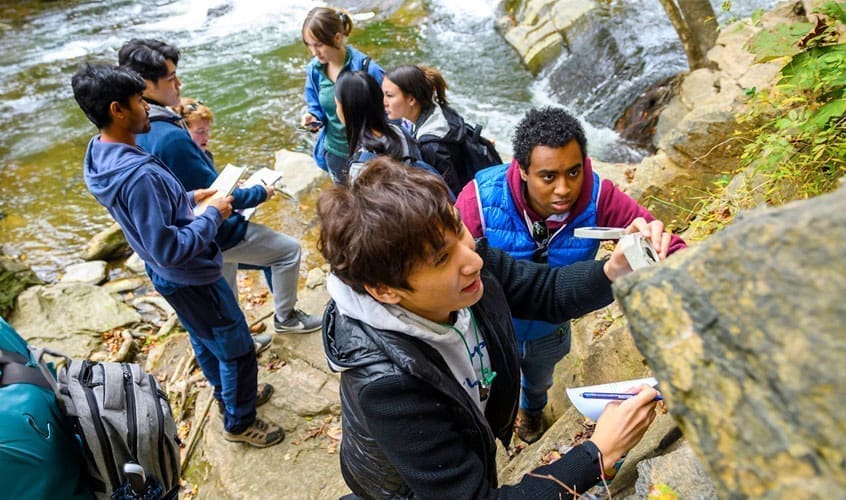
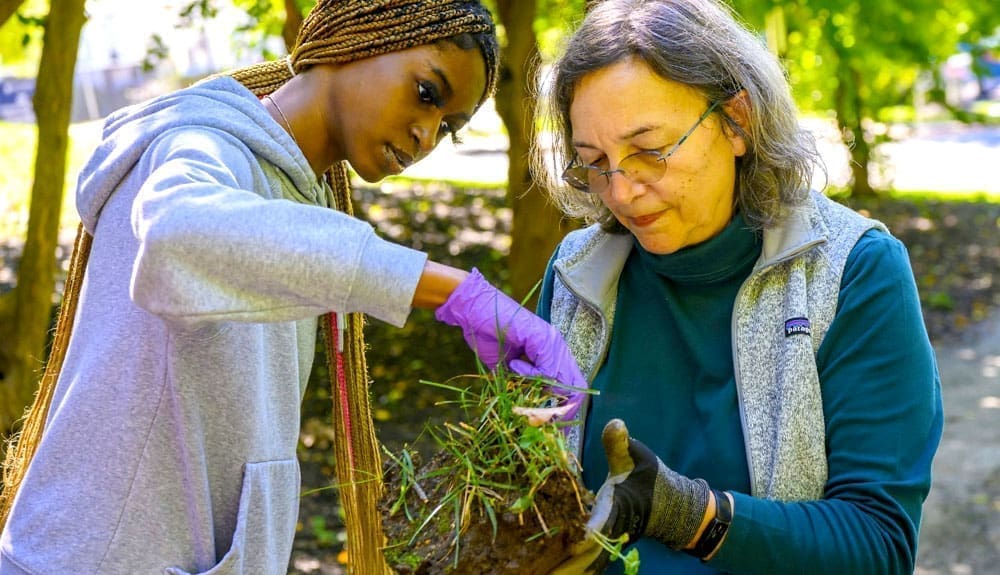
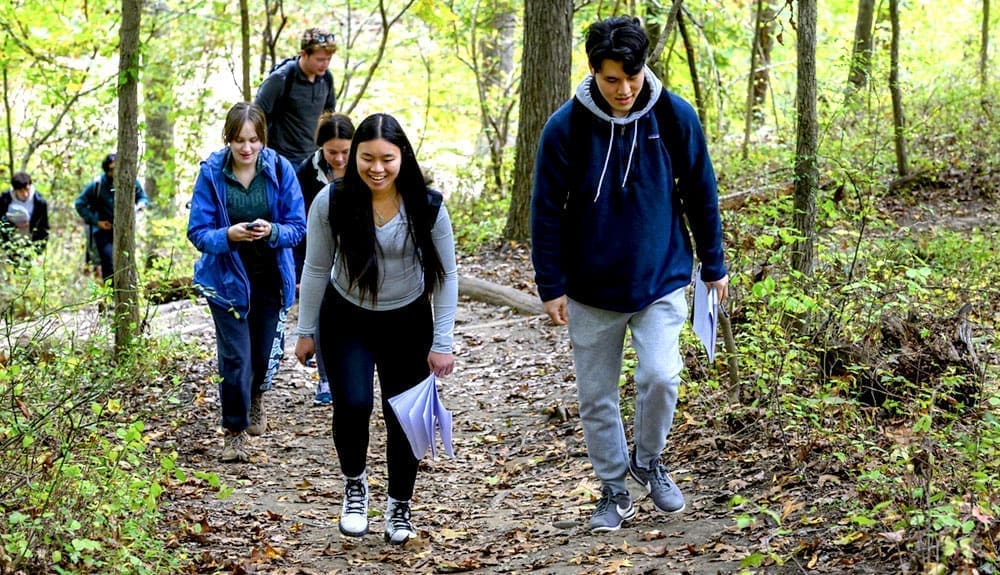
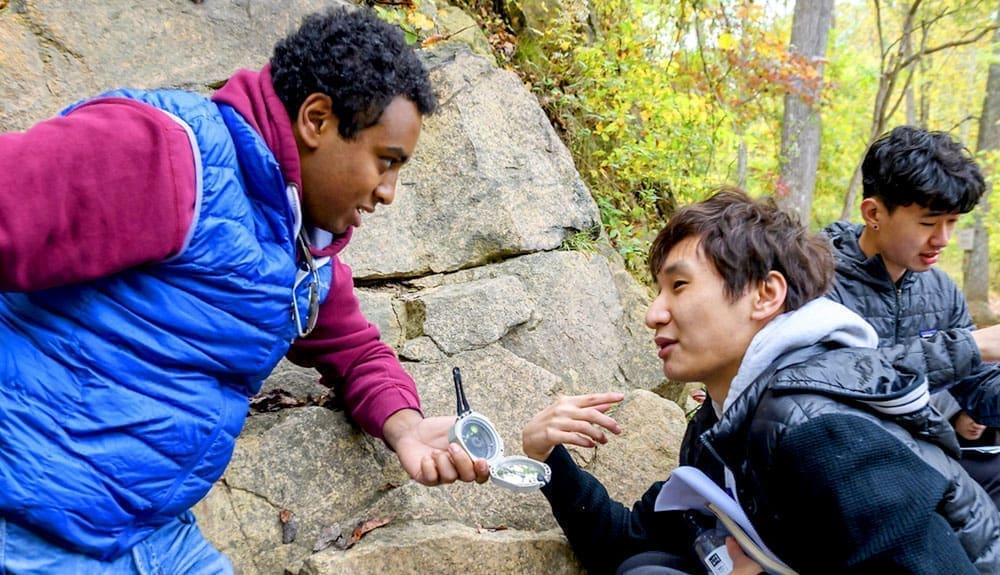
A key component of the GECS major will be senior projects, internships, and field trips that will give students “hands on” experience. These projects could be coordinated with other activities at JHU, including those of the Hopkins Sustainability Committee, and could also lead to greater outreach activities.

To further enhance the students’ perspective of the global nature of the issues and differences in world views of different cultures, the major will cultivate and nurture relationships with international institutions to provide a variety of culturally and academically challenging opportunities abroad to augment the JHU experience.

Course Requirements:

Requirements for the major will include a total of 23 or 24 courses and 78 or 75 credits respectively, depending on the concentration. These can be selected from a diversity of offerings available from different departments. GECS major students must take a “core” of 12 courses listed in Table 1 that will provide them with the foundations of global environmental science and sustainability. Core courses are offered through E&PS, Mathematics, Economics, Chemistry, Engineering, Psychology, Sociology, and Political Science. For electives, the major draws upon additional pertinent course offerings from these departments as well as from Anthropology, Biology, Physics, and History. Economics, Sociology, and Political Science are relevant to global environmental change and sustainability, both in their contributions to the problems we face and in their potential contributions to solutions to achieving sustainability. JHU is fortunate to have many courses from these disciplines with vitally relevant content. As such, these three disciplines contribute the majority of the Social Science Elective courses.

  1. Core courses:  12 core courses required for all GECS majors are listed inTable 1 below.
  2. Science Track core courses are listed in Table 2 below. In addition to these Science Track core courses, students choosing this track must take an additional 2 upper-level courses from Table 3: Major Electives in Earth and Environmental Science and 4 courses from Table 4: Major Electives in Social Sciences, 2 of which must be upper-level.
  3. Social Science Track majors must take 2 courses from Table 3: Major Electives in Earth and Environmental Science, at least 1 of which must be upper-level, and 10 courses from Table 4: Major Electives in Social Sciences, at least 6 of which must be upper level.
  4. Because GECS is inherently interdisciplinary, students fulfill the University’s distribution requirements by completing the requirements for the major.
  5. Capstone Experience
    1. Majors will be required to complete a senior capstone experience in conjunction with the Director and relevant faculty. The capstone will consist of a senior project, based on research, internship, or independent study, and will be a demonstration of integration and synthesis of knowledge and skills obtained during the 4-year program.
    2. Majors will be encouraged to begin planning their capstone experience during their junior year and will be required to submit a proposal by the end of September of their senior year. Subsequent milestones will be designated throughout the senior year to ensure that all majors are making satisfactory progress on their projects.
    3. Prerequisites for the capstone course include current status as GECS Major, completion of all core courses, and an acceptable plan for completing all requirements for the major by end of the senior year, or approval of Director.
    4. Credit for work in earlier terms using standard research, internship, or independent study courses can be applied to the capstone experience.
    5. All majors will make an oral presentation about their capstone experience to involved faculty, advisors, and parents at the end of their senior year.

Honors Program:
Majors with a GPA of 3.5 or above through their junior year will be eligible to do an honor’s thesis as part of their capstone project. Successful completion of the honor’s thesis will result in the conferring of a B.A. with Honors.

Curriculum for Minor

The GECS minor consists of seven courses (Table 5). All minors are required to take two core courses: Intro to Global Environmental Change provides the necessary content about the science of the Earth and its environments and Intro to Sustainability covers a thorough overview of the interactions between humans and the Earth’s systems and how those interactions could become sustainable. Students then have a choice of one of three other science courses that further explores a subset of interactions of humans with Earth’s living and nonliving systems, depending on the student’s area of interest. Students must choose two more courses from the list of Earth and Environmental Science Electives (Table 2) and two more courses from the list of Social Science Electives (Table 3)and two more courses from the list of Social Science Electives (Table 4 ).At least one course from each elective list must be upper level. A total of five Earth and Environmental Science courses provide the science basis of the minor, which is then rounded out with two relevant Social Science courses. Because students will be acquiring the methodological tools of their major discipline, this curriculum removes the science methodology required in the GECS major, while keeping the most important core content.

For more information contact:
Cindy L. Parker MD, MPH
Director, GECS Major
CIPARKER@JHSPH.EDU


Required Courses for all GECS Majors: Table 1
Science Concentration Core Courses: Table 2
GECS Electives in Earth and Environmental Science*: Table 3
GECS Electives in Social Sciences**: Table 4
Required Courses for GECS Minor: Table 5

Table 1: Required Core Courses for all GECS Majors:

Course Number

Course Title

Instructor

Credits, (category), prerequisites

270.103

Intro. to Global Environmental Change

Szlavecz /Olson

3(N)

270.107

Introduction to Sustainability

Parker

3 (N)

030.101/105

Chemistry I + lab

Staff + Pasternack

3 + 1 (N)

110.106/108

Calculus I

Staff

4 (Q)

180.102

Microeconomics

Hamilton

3 (S) same as .101

270.501

Capstone Seminar for GECS Majors

Parker

3 (N), All GECS core courses completed


Choose 1 of:


550.111

Statistical Analysis I

Fishkind, Torcaso

4 (Q,E)

280.345

Introduction to Biostatistics

Staff

4 (Q) 3 yrs high school math

230.205

Introduction to Social Statistics

McDonald

4 (S,Q)


Choose 2 of:


190.102

Intro Comparative Politics

Blyth, Tsai

3 (S)

190.209

Contemporary International Politics

David

3 (S)

190.211

Intro to Political Economy

Blyth

3 (S)

190.213

International Politics

Deudney

3 (S)


Choose 2 of:


270.308

Population and Community Ecology

Szlavecz

3 (N) none

270.360

Climate: Science & Policy

Waugh

3 (N) none

270.320

The Environment & Health

Kensler

3 (N)


Choose 1 of:


200.101

Introduction to Psychology

Drigotas, Holland

3 (S)

200.133

Introduction to Social Psychology

Drigotas

3 (S)

230.101

Introductory Sociology

Staff

3 (S)

230.150         

Issues in International Development

Agarwala

3 (S)

Back to top

Table 2: Science Concentration Core Courses

Course Number

Course Title

Instructor

Credits, (Category), prerequisites

110.107/9

Calculus II

Staff

4 (Q)

030.102

Chemistry II + lab

Staff

4 (N)

270.307

Geoscience Modeling

Haine

3 (N,Q)


Choose 2 of:


171.101/103

Physics I + lab

Staff

5 (E,N)

171.102/104

Physics II + lab

Staff

5 (E,N)

020.151 +.153

Biology I + lab

McCarty, Pearlman, Shingles

4 + 1 (N)

020.152 + .154

Biology II + lab

McCarty, Pearlman, Shingles

4 + 1 (N)


2 courses from Table 3: Earth and Environmental Science Electives; both must be upper level

4 courses from Table 4: Social Science Electives; and at least 2 must be upper level

Social Science Concentration
2 courses from Table 3: Earth and Environmental Science Electives; at least 1 must be upper level
10 courses from Table 4: Social Science Electives; at least 6 must be upper level

Back to top

Table 3: GECS Electives in Earth and Environmental Science*

Course Number

Course Title

Instructor

Credits, (Category), prerequisites

270.104

History of the Earth and Its Biota

Hinnov

3 (N)

270.108*

Oceans and Atmospheres

Haine,Waugh

3 (N)

270.220

The Dynamic Earth: An Introduction to Geology

Veblen, Ferry

3 (N) 030.101 or 171.101-102

270.308*

Population and Community Ecology

Szlavecz

3 (N)

270.315

Principles of Natural Catastrophes

Olson

3 (N)

270.320

Environment and Health

Kensler

3 (E)

270.332

Soil Ecology

Szlavecz

3 (N) 270.308 or Instructor’s permission

270.360

Climate: Science and Policy

Waugh

3 (N)

270.369

Geochemistry of Earth and Environment

Sverjensky

3 (N)

270.377

Climates of the Past

Hinnov

3 (?) 270.120 or Instructor’s permission

270.3xx

Combining Models and Measurements

Haine

3 (N,Q)

360.236

Ecuador and Galapagos Islands

Fortune

3

420.633*

Introduction to GIS

Staff

3 (?)

570.108

Introduction to Environmental Engineering

Ellis, Alavi

3 (E)

570.239

Current/Emerging Environmental Issues

Roberts

3 (E,N) Chem II

570.328

Geography and Ecology of Plants

Brush

3 (N)

570.353

Hydrology

Hilpert

3 (E) diff equations, fluid mechanics

570.395

Principles of Estuarine Environment: The Chesapeake Bay

Brush

3 (N)

570.411

Environmental Microbiology

Ward/Bouwer

4

570.424

Air Pollution

Ellis

3 (E)

570.443

Aquatic Chemistry

Stone

3 (E,N) 1 yr each chem &  calc.

 *These courses satisfy requirements for the MSc in Environmental Sciences and Policy

Back to top

Table 4: GECS Electives in Social Sciences **


Course Number

Course Title

Instructor

Credits, (Category), prerequisites

070.132

Invitation to Anthropology

Das

3 (H,S,W)

070.219

Anthropology and Public Action

Guyer

3 (H,S,W)

070.327

Poverty’s Life: Anthropologies of Health and Economy

Han

3 (H,S,W)

140.302

Rise of Modern Science

Kingsland

3 (H,S)

140.360

Changes in the Land: Science, Technology, and the American Environment

Kingsland

3 (H,S,W)

180.101

Elements of Macroeconomics

Maccini, Ball

3 (S), basic facility with graphs and algebra

180.215

Game Theory and the Social Sciences

Young

3 (S)

180.227

Economic Development

Gersovitz

3 (S) 180.101-102

180.231

Comparative Economic Systems

Morgan

3 (S) 180.101-102

180.241

International Trade

Staff

3 (S) 180.101-102

180.252

Economics of Discrimination

Morgan

3 (S) 180.102

180.266

Financial Markets and Institutions

Fohlin

3 (S)

180.280

Population Economics

Staff

3(S) 180.101-102

180.301

Microeconomic Theory

Staff

4.5 (S) 180.101- 02

180.302

Macroeconomic Theory

Ball, Maccini

4.5 (S) same as above

180.311

Intro to Economics of Uncertainty and Information

Karni

3 (S) 180.301

180.365

Public Finance

Carroll

3 (S) 180.301

190.101

Introduction to Comparative Politics

Keck, Tsai

3 (S)

190.209

Contemporary International Politics

David

3 (S)

190.211

Introduction to Political Economy

Blyth

3 (S)

190.213

International Politics

Deudney

3 (S)

190.304

Introduction to Public Policy

Sheingate

3 (S) upper-level students

190.309

Politics and Policy Design

Teles

3 (S)

190.316

An Introduction to Globalization

Hazbun

3 (?)

190.323

Introduction to International Law

Grovogui

3 (S)

190.363

Politics of International Development

Tsai

3 (S,W)

190.411

Environment and Development in the Third World

Keck

3 (S,W)

195.477-478

Introduction to Urban Policy: Seminar and Internship

Newman

3 seminar      3 internship

200.133

Introduction to Social Psychology

Drigotas

3 (S)

200.205

Behavior Modification

Fogel

3 (S)

200.343

Motivation

Petri

3 (S,N)

220.146

Introduction to Science Writing

Finkbeiner

3 (H,W)

230.101

Introductory Sociology

Staff

3 (S)

230.150

Issues in International Development

Agarwala

3 (S)

230.213

Social Theory

Andreas

3 (S,W)

230.306

Economic Sociology

Arrighi

3 (S)

230.313

Space, Place, Poverty, and Race: Sociological Perspectives on Neighborhoods and Public Housing

DeLuca

3 (S,W)

230.335

Political Sociology

Silver

3 (S)

230.342

Gender and International Development

Agarwala

3 (S)

230.349

Globalization and Social Movements

Silver

3 (S)

230.391

Theories of International Development

Silver, Arrighi

3 (S)

420.614*

Environmental Policymaking

Staff

3

420.656*

Environment Impact Assessment and Decision Methods

Staff

3

570.109

Environment and Society: Towards Sustainability

Norman

3 (E,N)

570.334

Engineering Microeconomics

Norman

3 (S) Calc III or permission of instructor

570.404

Political Ecology

Schoenberger

3

570.406

Environmental History

Schoenberger

3 (H,S)

570.427

Natural Resources, Society and the Environment

Schoenberger

3 (S)

**The list of acceptable Social Science Electives will be reviewed and updated annually by the Director, with guidance from the Advisory Committee. Courses no longer taught will be removed, although credit earned for courses that are removed will still count toward GECS major requirements as long as the course was on the list when it was taken, and new courses will be added. Relevant courses not included in the elective list may be able to be substituted for an elective with approval of the Director. Students wishing to make such a substitution should submit a substitution request in writing via email to the Director explaining the justification for the substitution and include the syllabus from the proposed course.

Table 5: Required Courses for GECS Minor

Course Number

Course Title

Instructor

Credits, (category), prerequisites

270.103

Intro. to Global Environmental Change

Szlavecz /Olson

3(N)

270.107

Introduction to Sustainability

Parker

3 (N)

Choose 1 of:


270.308

Population and Community Ecology

Szlavecz

3 (N) none

270.360

Climate: Science & Policy

Waugh

3 (N) none

570.320

The Environment & Health

Kensler

3 (N)


2 courses from Table 3: GECS Electives in Earth and Environmental Science; at least 1 must be upper level

2 courses from Table 4: GECS Electives in Social Sciences; at least 1 must be upper level


Back to top


About the Department | Undergraduate Program | Graduate Program |
Calendar of Events | People Directory News | Contact Information | Home

 © The Johns Hopkins University. All rights reserved.