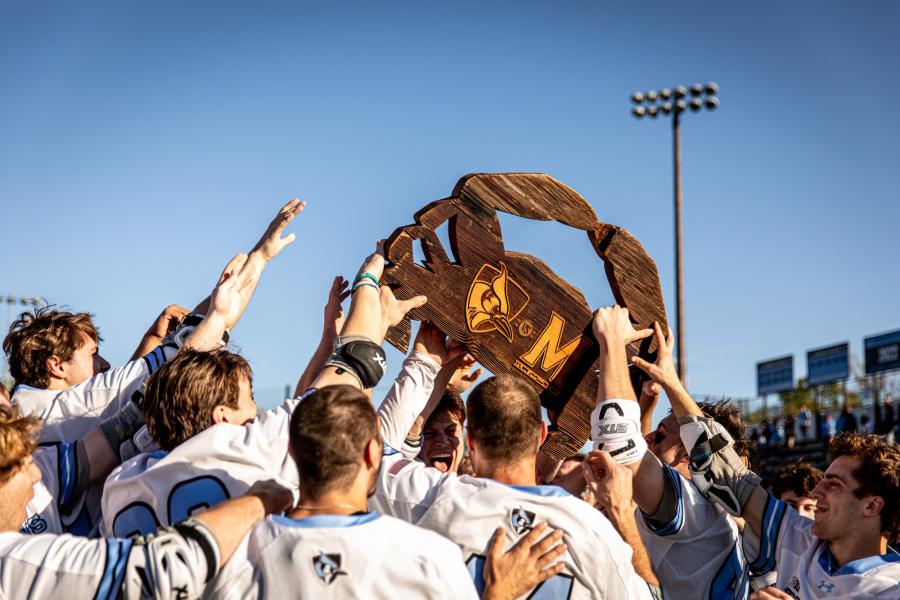
Hopkins's loss to Great Britain in the 1928 Olympic Games might have ended in a tie--were it not for the fact that the Hopkins player who scored what would have been the tying goal, with just a few seconds to go, was ruled to have been in the crease. Worse yet, it was the Hopkins team that had lobbied to have a crease in the first place.
Here's what happened: The Canadians and Brits played by different
rules than the Americans, allowing for no substitutions, no
offside restrictions, and no crease. Though Hopkins team
negotiators agreed to go along with the first two differences,
they were adamantly opposed to the third. Olympic refs
compromised by establishing a four-foot crease. (The American
standard was six feet.) Those negotiations came back to haunt the
Blue Jays when the last-minute goal was ruled no good. The day
after the Hopkins loss, Great Britain fell to Canada, 9-5, and
the Olympic contest ended in a three-way tie among the three
countries.
The Hopkins players may not have brought home the solitary gold, but they did sail back from Amsterdam with a load of memories. "Nobody ever had as much fun as we did," recalls second defenseman Robert Roy '28, dean emeritus of the School of Engineering, who today is 88 years old. Much of the jollity took place on the S.S. President Roosevelt, the steamship that carried America's 250+ Olympians (including swimmer Johnny Weismuller), as well as Major General Douglas MacArthur, president of the U.S. Olympic Committee.
Roy tells of shipboard romances between his teammates and the pretty young women on the U.S. swimming and diving team, and of high-stakes blackjack games with a (cheating) wrestler named "Tex."
Four years later, the Hopkins team again won the right to represent the United States, and this time the Blue Jays emerged as Olympic champions. Playing before a total of 145,000 fans in Los Angeles, Hopkins triumphed over sole competitor Canada by winning two out of three games.
Go Back to JHUNIVERSE Home Page