

We develop new methods to fabricate very small devices and integrated structures, and characterize these systems using microscopy and spectroscopy. Specifically we are interested in micro/nanoscale systems and self-assembly with applications in electronics and medicine. Additionally, since the role of interfaces becomes extremely important as the size of the system decreases, we utilize state-of-the-art experimental tools in surface science to probe interfacial phenomena at the molecular scale. Our research is multidisciplinary and we have students with backgrounds in Chemical and Biomolecular Engineering, Mechanical Engineering, Chemistry, Materials Science, Electrical Engineering, Biomedical Engineering and Medicine.


From left to right: a) Animation created by David Fillipiak, illustrating wafer scale surface tension driven self-assembly of cubic containers (b) Actual video (30x) of a container self-assembling [Leong et al, Langmuir 23(17), 8747-8751 (2007)] (c) Actual video of wafer scale thin film stress driven assembly of containers [Leong et al, Small (2008) (DOI: 10.1002/ smll.200800280)] (d) Animation created by Dave Fillipiak of a microgripper actuated by thermal or chemical cues picking up a bead.


From left to right: a) Reconfigurable microfluidics with metallic microcontainers [Leong et al, JACS, 128 (35) 11336-11337 (2006)] (b) Video of the spontaneous assembly of thin film sheets with patterned moduli and stress to form complex 3D structures such as helices, spirals and cylinders [Bassik et al, Advanced Materials (2008) (DOI: 10. 1002/adma. 200801759) in press]. (c) On-demand encapsulation of a bead in water [Leong et al, Small (2008) (DOI: 10.1002/smll.200800280)] (d) These gels move on their own: Solvent driven motion of lithographically patterned NiPAMM gels [Bassik et al, Langmuir (2008) ASAP]. {Please note: Videos have been sped up by 5-15X}
Our research has the following key thrust areas:
Funding: NIH-R21, NIH Director's New Innovator Award, Beckman, Dreyfus Foundations
We are developling minimally invasive micro-nanoscale surgical tools and biomedical devices using a new strategy developed in our laboratory that is based on the self-actuation and self-assembly of lithographically patterned templates. Recently, we fabricated the first-of-their-kind, mass producible, mobile grippers and demonstrated the capture and retrieval of microscale objects without batteries, wiring, or tethers. In contrast with present day endoscopy tools that utilize tethers (and hence are difficult to manipulate around corners and in coiled geometries), the mobile grippers were used to demonstrate the first tetherless, remotely guided, in vitro biopsy within a narrow tube. We plan to build on these preliminary results to develop an entire mobile and remotely actuated toolbox (including grippers, cutters and locomotors) for microsurgery.
We have also engineered a new class of remote controlled containers for in vitro lab-on-a-chip applications and in vivo drug delivery. The devices are small enough to fit through a hypodermic needle, thereby facilitating minimally invasive implantation and guidance in hard to reach micro-spaces. We plan to advance the functionality of these self-loading miniaturized containers by incorporating modules for sensing, imaging and telemetry within them. Our research goals are unique in that we seek to utilize mechanisms for motion and assembly that are harnessed within the structure, obviating the need for external tethers. Hence, apart from being technologically relevant, these paradigms are intellectually stimulating as they also enable the possibility for autonomous control of miniaturized machine-based function in human engineered biomedical systems. For in-vivo applications, we collaborate with the large number of medical researchers, doctors and clinicians on the Hopkins campus, especially through the Johns Hopkins School of Medicine.
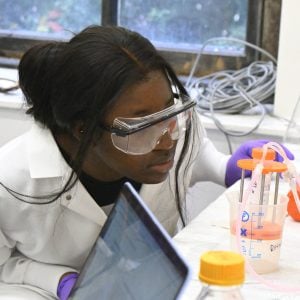
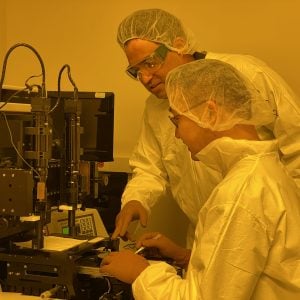
Students in our groups cleanroom, 3D lithographically structured nanoliter containers, remote controlled chemical delivery, self-loading containers and self-actuating grippers.
Funding: NSF-Career, NSF-MRSEC, JHU-APL partnership
The paradigm of present day manufacturing of structures at the micro and nanoscale is centered on the lithographic transfer of a pattern onto 2D substrates. This manufacturing process is precise and has been widely utilized. Conventional lithographic patterning, however, has had limited success in the patterning of structures in 3D. There are advantages of patterned 3D devices as compared to their 2D counterparts; these advantages include greater surface area to volume which allows enhanced diffusion in delivery systems, higher packing densities, small form factors, and encapsulated finite volumes. It is easy to achieve macro-scale engineering in 3D; however, despite all the progress in conventional micro-engineering, it is still extremely challenging to mass produce patterned 3D microdevices in a cost effective manner.
We have developed new strategies for the self assembly of complex untethered 3D microdevices (Figure). Specifically we have demonstrated the assembly of nanoporous containers, complex patterned 3D structures that self-assemble from thin film sheets (the sheets have patterned moduli and stress) [3] and three-axis sensors. The highlight of this strategy is that it is compatible with conventional lithography; the self-assembly transforms the two dimensional patterning to 3D. The fabrication process scales across dimensions and is highly parallel, thereby enabling cost effective manufacturing of 3D devices. Additionally, we have discovered spontaneous pattern formation in a thin film gold-chromium-silicon (Au-Cr-Si) multilayer system due to reaction-diffusion ; these reaction-diffusion systems are important to the self-assembly of dynamic and living systems.

Figure (A) Demonstration of self assembly of large numbers of patterned micropolyhedra [29]. (B) Self-assembly of orthogonal three-axis cantilever sensor probes. As opposed to conventional 2D measurement devices, these 3D devices enable measurement along all three axes [37]. (C) 3D self-assembled cylindrical scaffolds for cell culture. In addition to cylinders, patterned coils, spirals and helices assemble spontaneously from thin film sheets with patterned moduli and stress [41]. (D) Spontaneous pattern formation discovered in a heated uniform gold-chromium-silicon thin film system. Concentric patterns occur as a result of reaction-diffusion driven chemical reactions [36].
3) Nanowire electronics and sensors
Funding: NSF, DTRA, DIA
While a single nanowire device is a useful component in nanotechnology, when positioned precisely on a substrate, or when integrated with other nanowires can result in integrated functional devices. In our group we develop methods to integrate patterned metallic, semiconducting and insulating nanowires with molecular coupling agents, surface tension modifiers and electrical and magnetic forces. We are currently developing methods to integrate very large scale (>10,000 nanowires) nanowire networks in 3D. Fully 3D electronic integration will allow for ultradense, strongly connected systems with small form factor and short interconnects.We are also investigating the use of nanowire networks as sensors for chemical detection.

Directed assembly of nanowires to form (A) Stable nanowire bundles and (B) networks bonded by adhesives [17]. (C) Diffusion bonded 3D electrically conductive nanowire networks [26]. (D-E) Nanoscale soldering of nanowire chains and individual joints [19-21].
Funding: NSF
We use state-of-the-art experimental techniques in surface science including sum frequency spectroscopy, atomic force microscopy, scanning tunneling microscopy, x-ray photoelectron spectroscopy to probe organic transistor and biological interfaces.
Organic Field Effect Transistors (OFETs) have attracted considerable attention recently as an enabling component for “organic” or “plastic” electronics. Plastic electronics has several advantages over silicon based electronics in terms of the possibility of low cost, roll to roll processing and the development of electronics on flexible substrates. However, considerable challenges in organic semiconductors such as low mobility, irreproducible electrical characteristics and long term stability need to be overcome for OFETs to gain widespread acceptance.
We have developed instrumentation that integrates an SFG spectroscopy system with a four point electrical probe station. This unique instrumentation allows acquisition of SFG spectra simultaneously with electrical measurements on microfabricated contact pads on a planar device and allows us to probe molecular structure and electronic properties simultaneously. The structure-property relationships obtained from these studies will be used to develop a rational framework, to guide both the synthesis of molecules, as well as thin film processing parameters, with the end goal of addressing major implementation roadblocks in organic electronics including low mobility, irreproducibility and insufficient chemical stability.
We are also using SFG, and other surface science tools to understand adsoprtion and interaction of amino acids, proteins and peptides adsorbed at interfaces.